
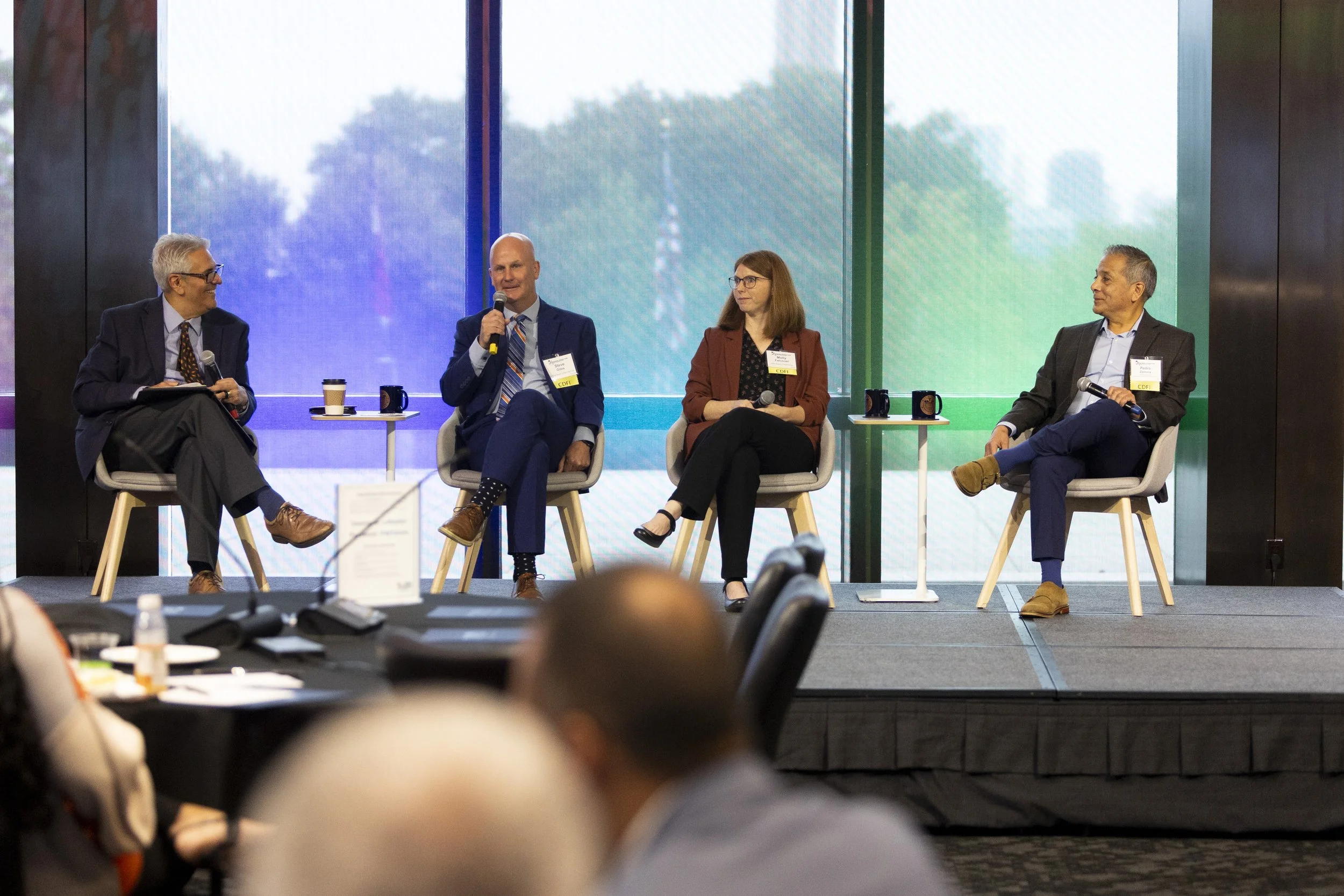
Last Tuesday, the KC CDFI Coalition and other regional Community Development Financial Institutions (CDFIs) hosted an event with the Federal Reserve Bank of Kansas City titled “Understanding CDFIs in Kansas City,” which explored the CDFI landscape in the Kansas City metro. Over the course of the morning, eight local CDFI leaders spoke to an audience of lenders and Community Reinvestment Act (CRA) officers from regional financial institutions, community organization leaders, and local philanthropy representatives.
To set the context for the convening, the morning opened with key takeaways from the Federal Reserve Bank of Richmond’s 2025 CDFI Survey. The survey found that demand for CDFI capital remains strong, access to capital is a top challenge for most CDFIs, and CDFIs expect demand for their capital to increase during periods of economic uncertainty.
From the start, the message to the audience was clear: to expand their impactful work in the community, CDFIs need better access to low-cost capital, especially as the future of federal funding becomes less certain.
Next came an overview of the CDFIs in the room, including their structures, common sources of capital, and examples of partnerships. As Geoff Jolley, Executive Director of LISC Greater Kansas City, noted, “We’re all making stew, just different kinds and using different ingredients,” referring to how each CDFI has unique clients, footprints, products, and sources of capital.
Up next, a panel discussion on the functions of different CDFIs reinforced the uniqueness of each organization and how CDFIs approach lending differently than traditional financial institutions.
Molly Falconer, Chief Development Officer of Holy Rosary Credit Union, said that being a CDFI gives the credit union the flexibility to incorporate character into its underwriting rather than being beholden to traditional credit metrics.
An important moment came when panelists were asked to name a common misconception about CDFIs. Pedro Zamora, Executive Director of the Hispanic Economic Development Corporation, said that CDFIs are not competing with banks for customers and, in fact, make natural partners through borrower referrals, loan participations, investments, and lines of credit.
The final panel discussed how CDFIs measure and communicate community impact. CDFIs generally share their impact quantitatively, using the data they collect and the metrics they track for the types of lending they do, and qualitatively, by sharing individual success stories of particular investments.
CDFIs also use impact metrics to guide their operations. Ruben Alonso, CEO of AltCap, said that low credit quality among applicants has prevented AltCap from deploying more money into the community. To address this, AltCap began placing a bigger emphasis on personalized business support services such as business planning and credit restoration. Since implementing this program, AltCap has seen applicants’ credit scores and application strength increase, leaving more applicants loan-ready.
During the final round of questions and comments, Rob Givens, board member for AltCap and Holy Rosary Credit Union, summarized the day perfectly by breaking down the term “CDFI.” He noted that focusing on community development work while being a sound financial institution is hard, but both are essential to the missions of these organizations: “You can’t do good CD (Community Development) without being a good FI (Financial Institution).”
October marked the 49th anniversary of the CRA. This critical piece of legislation was enacted to counteract the harmful effects of redlining, the practice of intentionally denying low-income communities and communities of color access to financial products. In the same spirit as the CRA, Understanding CDFIs in Kansas City was designed to address knowledge gaps about CDFIs among individuals and institutions that are well positioned to support their work in creating a more inclusive and equitable economy.
The KC CDFI Coalition is a partnership of regional CDFIs that work together to provide accessible capital and resources to communities across the Kansas City metro.
Together, Coalition members promote the vital services CDFIs bring to communities and raise awareness of the persistent barriers between low- to middle-income communities and equitable economic growth.